
Read the Instruments in Clay County Deed Records
The Clay County Register of Deeds keeps the recorded instruments: deeds, cemetery deeds, mortgages, state and federal tax liens, plats, surveys, and sales-validation material. A deed names the parties and the land. Its type and wording control what interest actually passes, so read the label together with the full instrument rather than trusting the title alone.
| Deed Type | What It Does | Common Use |
|---|---|---|
| Warranty deed | Conveys the described interest with stated covenants | Ordinary sales |
| Quitclaim deed | Conveys whatever interest the grantor holds without warranty | Family transfers or corrections |
| Special-warranty deed | Limits covenants to the grantor's ownership period | Transfers with narrower assurances |
| Trustee or executor deed | Transfers through an authorized fiduciary | Trust or estate administration |
| Tax deed | Records a transfer after the statutory sale process | Tax-delinquent property |
A mortgage or lien is different in kind from a deed. It records a claim or security interest, not a new transfer of ownership. Follow it forward to any later release, satisfaction, or discharge before assuming it still encumbers the parcel.
Start With the Current Clay County Vesting Deed
Start with the parcel itself. Pull it up in the Clay Tax/CAMA search. Save the owner name, identifiers, and legal description shown there. Then ask the recorder for the newest conveyance matching those clues. Compare the deed's grantee against the tax name. Copy the recording date, reference, and land description exactly as written.
Tax rolls can lag a closing. A mailing taxpayer may not even be the vested party. When the assessment roll looks stale, the newest recorded deed is the stronger confirmation. It confirms who owns the land. It is still a starting point, not a title opinion.
Clay County Publishes No Verified Online Deed Cutoff
Clay County exposes no public grantor-grantee search page, no index fields, and no stated imaging cutover or earliest searchable year. That means nobody can honestly claim every Clay County deed record is online. Ask the office directly which deed books, index volumes, images, or microfilm cover the period you need.
The office sits at 712 5th Street, Suite 104, Clay Center, Kansas 67432, open weekdays from 8:00 a.m. to 5:00 p.m.; the phone number is 785-632-3811. Have your party names, approximate date, legal description, parcel or CAMA number, and any instrument reference ready. Ask about search help, copying, certification, mail procedure, and payment while you are at it. The official Register of Deeds page is the documented online entry point.
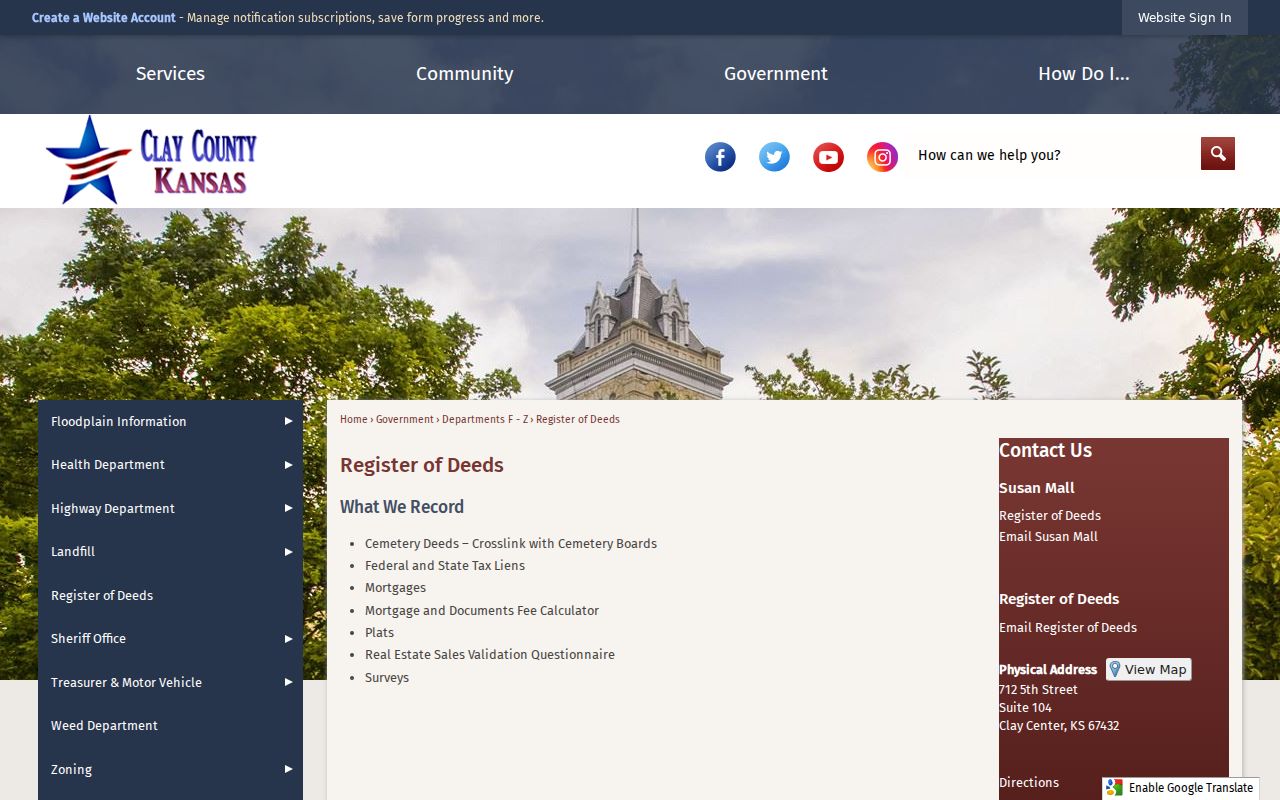
The office's own page confirms the scope of what it records, even without a public grantor-grantee form. Note: An unpublished web cutoff is not evidence of missing deeds; the recorder must confirm format and depth.
Walk Clay County's Grantor-Grantee Trail Backward
A grantor-grantee index tracks people, not addresses. Keep the legal description beside each name, because one party may have conveyed several Clay County properties over the years.
- Find the current vesting deed with the present party as grantee.
- Record its grantor, date, deed type, reference, and complete description.
- Search that grantor as an earlier grantee and match the same land.
- Repeat, moving to physical indexes or microfilm when digital coverage ends.
- Grantor
- The party conveying the stated interest.
- Grantee
- The party receiving the stated interest.
- Chain of title
- The linked sequence of recorded conveyances for the same land.
- Book/page or instrument number
- The recorder reference used to retrieve a document.
Match Clay County Plats and Surveys to the Deed
Descriptions differ by location. A town parcel may cite addition, block, and lot. Rural land leans on section, township, range, quarter calls, and acreage. Request any plat, survey, easement, dedication, vacation, or right-of-way the deed references. The ORKA map helps orient the tract. But it never substitutes for a recorded plat or survey.
Older records may rely on township, farm, route, or railroad descriptions. Maps, newspapers, obituaries, and family histories at the Clay County Museum can help. They can bridge an obsolete clue to a later owner name before you request the deed book.
Follow Mortgages and Tax Liens to Their Releases
Search under the debtor or owner and the land description. Pair each mortgage or lien with its later release, satisfaction, assignment, or discharge. An instrument with no visible online release deserves a call to the office. A missing image proves nothing about whether the claim is still active.
For entity-owned land, the Kansas Secretary of State business records confirm exact legal business names. Keep UCC filings separate in your mind. They cover personal-property financing statements rather than county land title.
Sales Validation Explains Some Price Differences
The Kansas Real Estate Sales Validation Questionnaire may capture consideration, deed date, parties, property use, and circumstances hinting a sale was not arm's length. Clay is a one-part county for this process. The questionnaire aids appraisal analysis. But it neither replaces the deed nor makes the stated price match the January 1 appraised value.
Compare the questionnaire's parties and date against the conveyance itself. Family transactions, estate events, partial interests, and odd conditions can all explain a gap. Deed consideration and appraisal figures may diverge for these reasons.
Request a Clay County Deed Copy From Its Custodian
Give the Register of Deeds the grantor and grantee, the approximate date, the deed type, the legal description, the parcel or CAMA number, and any known reference. Say whether you want an ordinary or certified copy. Request a fee estimate too, since the county page posts no complete copying schedule.
If the ordinary route fails to produce an identifiable public record, turn to the Kansas Open Records Act, K.S.A. 45-215 et seq. The custodian should respond by the close of the third business day with the record, a lawful denial, or a notice of extra time. Actual-cost fees and prepayment may apply.
Recorded, not guaranteed. Clay County deed records show filed instruments, not every possible unrecorded interest, defect, or boundary conflict. A certified copy is still not a title opinion.
Verify Deed-Copy Offers Before Paying
Official copies come only from the custodian. Check any unsolicited offer to sell a deed copy against the recorder before paying, and confirm wire, tax, or redemption instructions through a published county number. Clay County publishes no verified property-fraud alert signup, so never submit personal information to an unconfirmed enrollment page.
A practical monitoring routine takes three steps. Keep the deed reference on file. Review the assessment name after any transaction. Question any unfamiliar recording directly with the Register of Deeds.
Estate and Court Records Can Bridge a Clay County Deed Gap
A deed chain sometimes leaps over years without explanation. Probate, fiduciary deeds, foreclosure, partition, and quiet-title cases can all transfer title. This happens outside the ordinary grantor-grantee flow. When that happens, search Kansas CaseSearch by party name. Keep the case number, filing county, case type, and dates. The Clay County District Court clerk can then supply public petitions, orders, judgments, or probate documents. These name the land or authorize the conveyance.
The courthouse terminal still matters. Guest web access may show only basic case information or no document image at all. A visit to the clerk's counter often fills the hole. Sealed and restricted records stay off limits. The 2025 Kansas court transition does not promise that every historical Clay filing is online. Always compare any court-derived description against the eventual recorded deed. The docket alone is not the conveyance.
Older family-history clues may predate modern court indexing. The Clay County Clerk holds local birth, death, and marriage material from 1885 through 1911. The Clay County Museum reports marriage records reaching back to 1868 and running through 1969. Eligibility restrictions still apply to vital records. Names and dates from lawful research can sharpen an official land-record request.
Track Description Changes Across Clay County Deeds
A tidy owner-name chain can still conceal a broken legal description. Copy the addition, subdivision, block, lot, section, township, range, quarter, acreage, and exception language from every conveyance. Do this for every conveyance you handle. Watch for replats, surveys, easements, roads, alleys, dedications, vacations, splits, and combinations. New wording may restate the same tract. The tract itself may have changed.
Tax and CAMA legal-location fields help reconnect a current parcel. Then ask the recorder for any cited plat or survey. Country Club Hills and Prairie Meadows are verified unincorporated subdivision names. But an unfamiliar planning label deserves skepticism until a recorded plat backs it up. ORKA can supply context. It cannot resolve conflicting calls.
Rural deeds deserve special care. Township and quarter-section language often proves more dependable than a later route address. Highways, county roads, creeks, and railroad references help orient a search. They never replace the legal calls in the instrument itself.
Keep a Clay County Deed Research Log
Log every instrument with discipline. Record the exact indexed spelling, party roles, instrument type, execution and recording dates, retrieval reference, legal description, and source format. Give each mortgage, assignment, release, lien, satisfaction, plat, survey, or court order its own row. That habit keeps a name appearing in several transactions from being pinned to the wrong parcel.
Mark gaps instead of guessing. A missing web image may sit at the counter. An absent release may hide under another party's name. An ownership change may have traveled through probate or court, and the recorder, courthouse terminal, museum, and historical society each serve as documented fallback channels for different problems.
Note: Preserve exact spellings and description variants, because even a small difference can separate the correct Clay County deed from another party's instrument.
When requesting certification, state the purpose plainly. Ask the recorder which page or attachment must accompany the copy. A partial image can omit acknowledgments, exhibits, legal descriptions, or stamps needed to understand the recorded instrument.