
Identify Who Owns Clay County Land
Learning who owns a Clay County property works best when you follow the records trail. Don't guess from a name alone. The county tax and assessment system links each site to an owner of record and a parcel key. The recorded deed is the stronger proof. Trusts, estates, business entities, and mailing names can cloud the answer, though. Keep the exact parcel number and legal description handy at every step. A fresh transfer may not yet show across all county systems.
- Enter the property address, using separate street fields if a full phrase does not match.
- Open the likely result and copy the current owner spelling plus all parcel identifiers.
- Use ORKA to make sure the key fits the intended tract, not a nearby lot.
- Ask the Register of Deeds for the latest vesting deed and match its grantee and legal description.
Where Clay County Owner Information Comes From
No single county source settles ownership on its own. Clay County offers no public online grantor-grantee index, so final confirmation may take a trip to the Register of Deeds counter, a phone call, or a focused request. ORKA, meanwhile, identifies geography well but proves nothing about title.
| Source | Owner Info It Gives | Access |
|---|---|---|
| Tax/CAMA result | Owner name, account keys, address and legal-location clues | Free web form; tax data updates nightly |
| Recorded deed | Grantor, grantee, instrument and legal description | Register of Deeds request |
| Secretary of State | Registered business entity and resident-agent record | Free official entity search |
| ORKA parcel viewer | Mapped tract and parcel context | County-linked public viewer |
Watch the labels closely. The taxpayer or mail recipient on a Clay County record can differ from the title holder, and a situs address identifies the land while a mailing address only tells the county where notices go. Neither one proves occupancy. The focused current owner record explains how to weigh those different labels.
Check Fresh Clay County Deeds
Clay County publishes a valuation date. It also publishes later tax roll milestones. However, it sets no fixed interval between a recorded deed and the CAMA owner update. A nightly database refresh occurs. That refresh does not guarantee every new deed has changed the owner field. After a recent closing, ask the Register of Deeds for the newest vesting instrument. Match the grantee and the complete legal description, never just a familiar surname. One recorded deed can settle a stale roll. The county publishes no online deed-index cutoff. So the office is also the fallback whenever the web cannot answer.
Note: Clay County publishes no standard number of days between deed recording and the CAMA owner update.
Trace Clay County Entity Owners
A Clay County result may name an LLC, a trust, an estate, or joint owners. Copy every party name from the deed exactly. When a business appears as grantee, the Kansas business entity search can confirm it. Search by entity name, business ID, or resident agent. Registration is what that record proves, not each person's private economic interest.
- Owner of record
- The person or entity named in the current county record.
- Grantee
- The party receiving an interest in a deed.
- Vesting deed
- The recorded instrument by which the current interest was acquired.
- Situs address
- The physical property location, distinct from a tax mailing address.
Review Clay County Owner Context
The county's real-property information page explains the assessment setting behind the tax/CAMA owner entry.
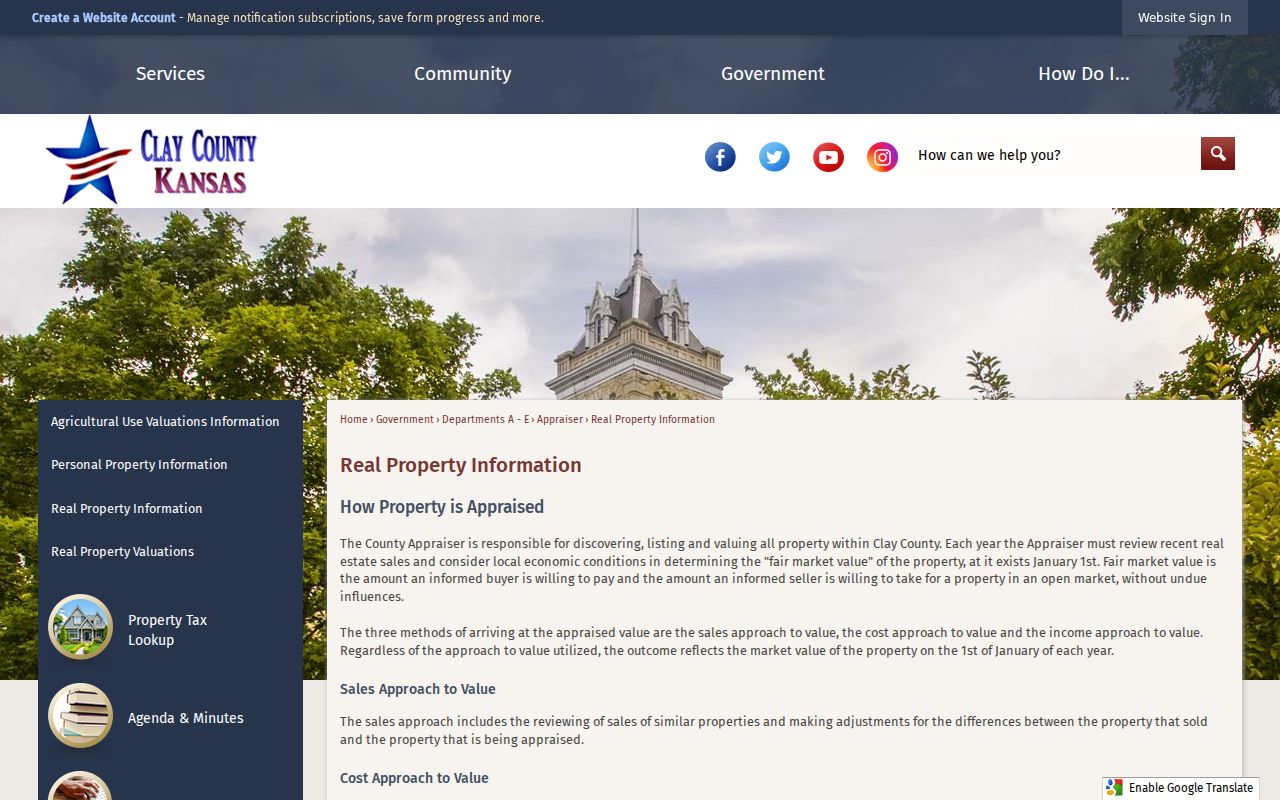
The county's valuation page adds useful ownership context. It is not a deed image, and it is not a title opinion.
Separate Clay County Owner Addresses
Clay County's search form splits a property address into parts. The parts include street number, direction, street name, suffix, post direction, unit, city, state, and ZIP. Those fields describe the situs. That is the address used to locate the parcel. A tax mailing address does a different job. It directs notices to the taxpayer or a designated recipient. An owner may collect mail at a business office or a post-office box. The mailing address can also sit far outside Clay County. Keep both addresses in your notes and label each one. Never substitute one for the other when requesting a deed. For rural land, section, township, and range may beat either address as the reliable key. The county form also supports subdivision, block, and lot searches for platted land.
A mismatch is a prompt to verify, not evidence of wrongdoing. Estate administration, entity ownership, a recent move, or simple mailing preference can all explain it.
Request Clay County Ownership Proof
When the web cannot settle who owns a Clay County parcel, assemble a short request packet. Include the property address, the CAMA or Tax ID, and the full legal description if you have it. Add the present owner name from the tax roll, an approximate transfer date, and the exact record you want. Ask the Register of Deeds for the latest recorded instrument that vested the described tract.
The office sits at 712 5th Street, Suite 104, Clay Center. It publishes weekday hours from 8:00 a.m. to 5:00 p.m. Its telephone number is 785-632-3811. These channels matter, because Clay County offers no official public deed-search portal. A counter or phone inquiry can also surface the book, page, or instrument detail. That detail is needed for a copy request.
A Kansas Open Records Act request is another route to an identifiable public record. Under K.S.A. 45-218, the custodian must act as soon as possible. The deadline is no later than the end of the third business day. That deadline may mean providing the record, denying it with a stated basis, or explaining the delay. Fees can reflect actual costs, including staff work or redaction, and prepayment may be required.
Resolve Clay County Ownership Conflicts
When two Clay County sources disagree about ownership, weigh what each one actually proves. ORKA pins down the mapped tract itself. The tax and CAMA system reports the administrative owner or taxpayer of record. Only the newest recorded deed documents the transfer itself, so it carries the most weight. A probate order, an executor deed, a quiet-title judgment, or a later corrective instrument can explain why a plain name comparison falls short.
District court files sometimes hold the missing context. Kansas CaseSearch shows basic case information. Public courthouse terminals may display records that never reach the web. Sealed material and documents outside portal coverage stay out of reach for an ordinary online search. Fix the parcel and the owner names first. Only then search by party and case type.
One caution matters here. A mortgage, a lien, a lis pendens, or a court filing is not a completed transfer of ownership. Each marks a different legal event. For the question of who owns a Clay County property, the deed and its legal description remain the controlling recorded proof.
Use Clay County Search Fields
The Clay County tax and CAMA search form offers several precise routes to a parcel. Name controls cover last name, business name, and first name. They also take a middle initial. Match mode is either begins-with or contains. Address fields split the pieces apart: street number, direction, and street name. Suffix, post direction, unit, city, state, and ZIP get their own boxes. The portal also accepts a CAMA number and an owner identification number. It takes the composed tax or parcel identifier too.
Platted land searches best through subdivision, block, and lot. Rural tracts respond better to section, township, range, quarter section, and the related legal-location fields. Start with the smallest stable key you actually know. A broad surname can drag in unrelated parcels. A full address can fail over a directional or suffix mismatch.
The county help page spells out field lengths and matching rules. It also separates the commands that clear, reset, and submit a search. An empty result calls for fewer terms, not more. Drop anything uncertain and retry. When a solid match appears, save its exact identifiers. Then chase the owner name through another public source.
Contact Clay County Record Keepers
For CAMA and assessment questions, the Clay County Appraiser is the office to call. Visitors will find the office at 712 5th Street, Suite B1, in Clay Center, reachable at 785-632-2800 or 785-632-5264 on weekdays from 8:00 a.m. to 5:00 p.m. The Register of Deeds sits in Suite 104 of the same courthouse square of records, at 785-632-3811, and holds the instruments a title confirmation depends on.
Make any request precise. Give the property address, the CAMA or Tax ID, the legal description, the current roll name, and a rough transfer date. Request the newest deed vesting the exact tract. If an estate or court order sits somewhere in the ownership path, the Clay County District Court clerk and the public courthouse terminal may hold the related case documents.
Record requests follow the Kansas Open Records Act. Under K.S.A. 45-218, a custodian must respond as soon as possible and no later than the close of the third business day, though a timely reply may note that production needs more time. Fees for staff time, copying, or redaction can apply, and prepayment may be required before the office produces the records.
Limit a Clay County Owner Search
An owner field has limits worth knowing. It does not reveal every occupant or private beneficial interest. It can also lag behind a recent transfer. Kansas offers Safe at Home address confidentiality, and public-record exceptions shield data the law does not require a custodian to disclose.
Lawful use. Use Clay County owner records for property research and due diligence. Never use them to stalk, harass, intimidate, or harm anyone.
An owner name is a lead, never a title search. When title matters, compare the latest recorded deed, any releases, and the precise legal description.