
Decode Clay County Property Tax Records
The Clay Tax/CAMA search connects property identification and tax clues. The Appraiser establishes fair-market value as of January 1; Kansas classification produces assessed value; the Treasurer administers billing and payment history.
| Field | What It Shows | Where |
|---|---|---|
| Appraised value | Fair-market estimate at the annual valuation date | County Appraiser |
| Assessed value | Appraised value multiplied by the statutory class rate | County Appraiser |
| Class and exemption | Tax classification and reflected relief | County Appraiser |
| Bill and status | Amount billed and current, paid, or delinquent status | County Treasurer |
| Tax unit and levy | County, city, school, and special-unit components | County Clerk and Treasurer |
The math is straightforward. Tax equals assessed value multiplied by the mill levy, then divided by 1,000. A recorded deed sale price is a separate transfer fact, so keep the date and definition attached to each number.
January 1 Anchors Clay County Valuation
The county valuation explanation anchors fair-market value to January 1 each year. The Appraiser studies sales and economic conditions. It draws on sales, cost, and income approaches as needed. The calendar then moves quickly. Value notices go out March 1. The Appraiser certifies values June 1. The clerk certifies the tax roll November 1, and statements follow December 1. That staggered schedule matters. It is why a deed, appraisal, tax bill, and payment record can each capture a different moment. The 2026 county materials name an inspection area. No exact deed-to-CAMA name-update interval is published.
Kansas Class Rates Change the Taxable Base
Class rates drive the taxable base in Clay County. Residential property is generally assessed at 11.5 percent of appraised value. Agricultural land is assessed at 30 percent. Vacant lots are assessed at 12 percent. Commercial or industrial property and agricultural improvements are assessed at 25 percent. Check the classification on a parcel before reproducing any calculation.
The County Clerk's levy work can draw on city, school, fire, cemetery, drainage, hospital, and other units. Because of that, two parcels with the same market estimate can still produce different assessed values or bills.
Look Up a Clay County Tax Bill and Status
The portal offers several search angles: current taxpayer, delinquent taxpayer, current owner, or owner and taxpayer together. It also accepts CAMA and Tax ID numbers, names, addresses, subdivision-block-lot combinations, and section-township-range descriptions.
- Search with the narrowest reliable address, name, parcel, or legal-location clue.
- Confirm the identifier and select the intended current or prior year.
- Save values, class, taxing units, exemption clues, amount, and status.
- Ask the Treasurer to confirm interest, penalties, fees, redemption, or sale status.
- Assessed value
- The taxable portion after applying the class rate.
- Mill levy
- Tax per thousand dollars of assessed value.
- Exemption
- Legally authorized relief verified for a parcel and year.
- Tax lien
- The public claim arising from unpaid tax.
Clay County Tax Information Updates Nightly
The county's online-resources page states that current and prior tax information updates nightly. The portal itself displays a database date, which appeared as September 7, 2026. The live tax search provides the self-service lookup.
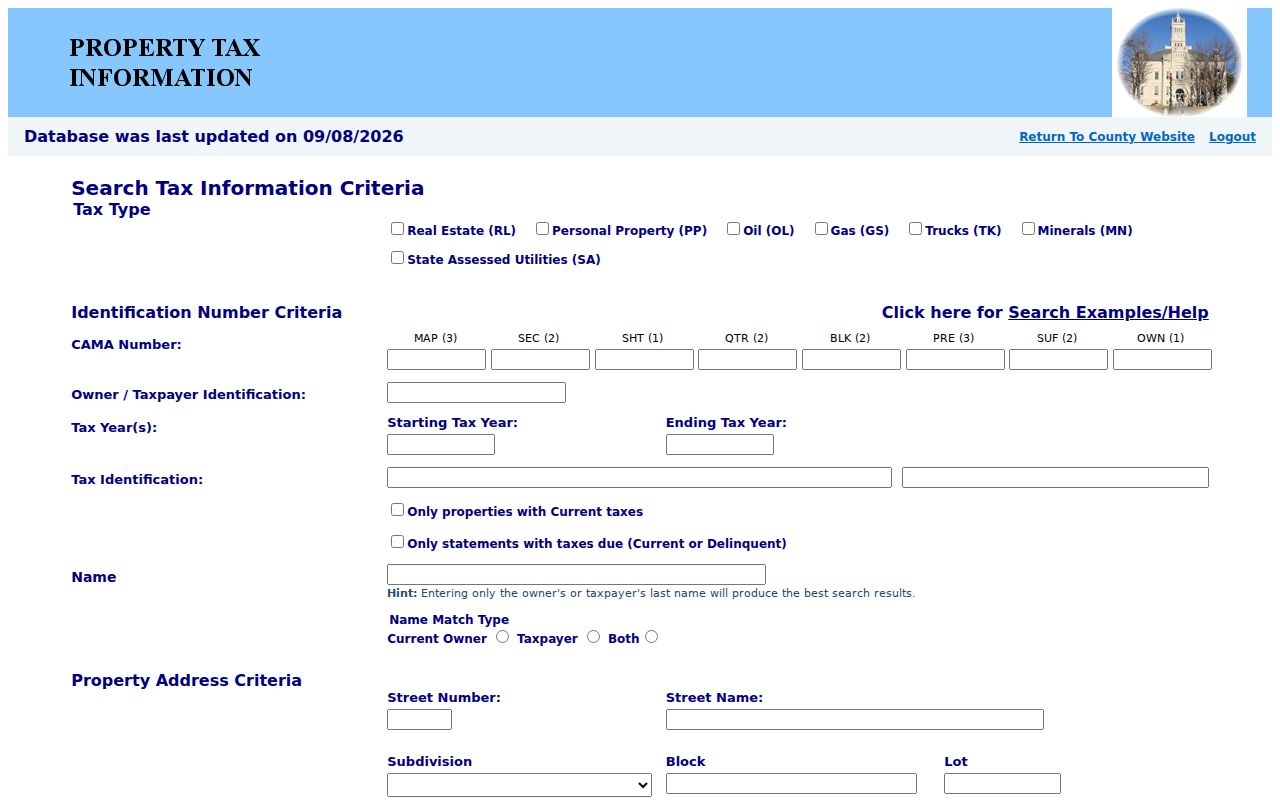
The form's many keys serve city lots and legally described rural tracts alike. Online figures exclude interest, penalties, and fees, so the Treasurer must confirm any payoff amount. The real-estate tax page sets the local schedule. First-half tax is due December 20. The second half is due May 10 when a bill is split. The official payment page documents those deadlines.
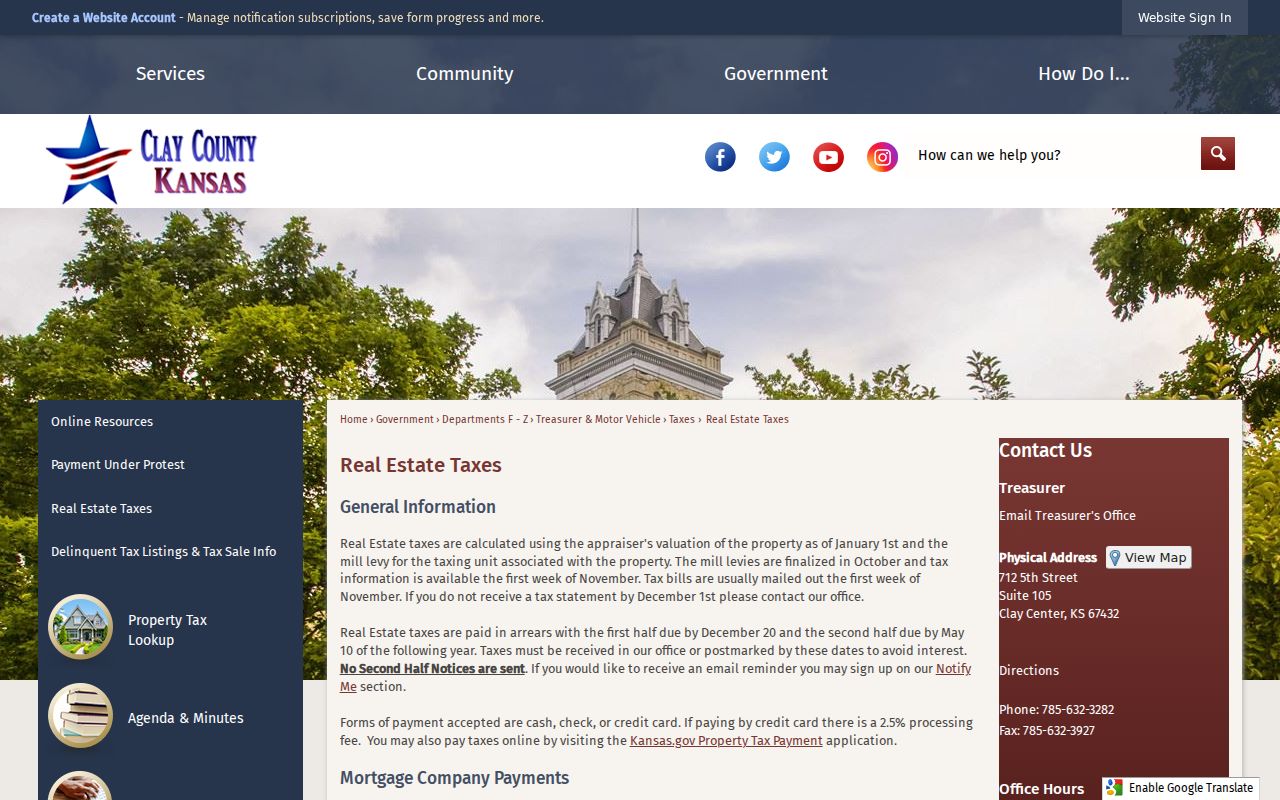
The published instructions are the controlling source for timeliness and payment channels.
Delinquency Can Advance Toward a Tax Sale
Unpaid tax pushes a parcel into the county's arrears, publication, redemption, and possible sale sequence. A $16 publication fee applies. The tax-sale page carries a notice dated December 18, 2025 listing legal descriptions, parcel IDs, delinquent years, approximate locations, redemption costs, and owner-of-record fields. A dated notice is not current status. Ask the Treasurer whether a parcel was paid, redeemed, or separately ordered. Ask also whether it still sits in proceedings.
Clay County Archives Valuations From 2008 Through 2026
The valuation archive offers annual city and township PDFs covering 2008 through 2026. It is the clearest digital time series for local value context. It says nothing about online coverage of the deed books. Match geography and labels carefully before calculating any trend. Shifts can stem from construction, valuation changes, class, exemptions, boundaries, or reporting differences. So a parcel appeal still calls for parcel-level evidence.
Contest a Clay County Assessment on Schedule
Contact the Appraiser promptly after a value notice arrives. Strong evidence includes the property information sheet, comparable sales, a purchase contract, photographs, repair estimates, damage documentation, and facts showing an incorrect class or legal description. An informal stage comes first. After that, a Kansas Court of Tax Appeals route may follow.
A separate payment-under-protest route includes a December 20 filing point, escrow and late-payment exceptions, an informal meeting, and further COTA review. Choose the procedure that matches your notice and payment posture.
Appeal window. Notice appeals and payment-under-protest filings have different triggers. Contact the Appraiser immediately and follow the date printed on the controlling form.
When the Clay County Tax Name and Deed Differ
The portal separates current owner from taxpayer, and a mailing address can differ from the situs address. No exact deed-to-CAMA refresh lag is published. After a recent sale, ask the Register of Deeds for the latest conveyance. Keep the legal description constant while comparing names.
Estates, trusts, and entities can change the displayed correspondence name. Valuation or parcel-fact errors belong with the Appraiser at 785-632-2800, while payment questions go to the Treasurer at 785-632-3282.
Build an Evidence Packet for the Clay County Appraiser
A strong valuation appeal rests on the county's own property facts. Start with the parcel number, class, land value, and improvement value. Include the total appraised value, assessed value, exemption details, legal description, and valuation year. Check the recorded building and land characteristics against what actually existed on January 1. Is the error about size, use, condition, or classification? Treat it as a factual mistake. Keep it separate from any broader quarrel with the market estimate.
Comparable sales carry the most weight. They should match location, use, age, quality, and condition close to the valuation date. Keep the sale dates. Flag any transfer that may not be arm's-length. The county's appeal guidance also recommends purchase contracts, photographs, damage evidence, and repair estimates. Submit copies and hold on to your originals. Then note the date and outcome of the informal meeting.
The Clay County Appraiser can be reached at ccappraiser@claycountykansas.org. You can also visit the county offices, 712 5th Street, Suite B1, Clay Center. Hours are Monday through Friday, 8:00 a.m. to 5:00 p.m. Ask which form and deadline apply to the valuation year in question. Do not rely on a general calendar.
Separate Exemption Questions From Tax Payment Questions
Route a question by its function. An exemption or property-class issue belongs with the Appraiser, since it shapes the assessment roll. A payment, receipt, installment, delinquency, interest, or payoff question belongs with the Treasurer. The County Clerk's records clarify taxing units and levies. Good routing keeps a payment clerk from being asked to change a value. It also keeps an appraiser from being asked to confirm cleared funds.
Agricultural-use documentation, construction worksheets, and other Appraiser forms can shift which facts support the valuation. Still, never assume an exemption from the owner's circumstances or mailing address alone. Confirm the applicable form, eligibility rule, tax year, and approval status in the official record.
When ordering records rather than asking about an account, state the parcel, year, document, and format you want. The Kansas Open Records Act allows actual-cost fees and prepayment. The three-business-day deadline governs action by the custodian, not completion of a complex request.
Read Clay County Tax Search Controls Precisely
The CAMA field breaks into MAP, SEC, SHT, QTR, BLK, PRE, SUF, and OWN segments. Tax ID works differently. It pairs a three-digit tax-unit code with a ten-digit parcel number. Never paste one identifier into the other's fields. Without either, search by name, address, subdivision and lot, or section-township-range.
Name search offers last, first, middle, and suffix boxes. The holding-type setting decides whether results reflect current owner, current taxpayer, or delinquent taxpayer. It can also show owner and taxpayer together. Address search splits number, direction, street, suffix, city, state, and ZIP. If an exact entry fails, drop the parts you are unsure of.
Current-tax, taxes-due, and year-range controls set the period shown. Save those choices with the result. A current account and an old delinquency can involve the same parcel. Yet they answer different questions.
Use the Treasurer for a Current Clay County Payoff
Treat online figures as a lead, not a final settlement amount. The county excludes interest, penalties, and fees from the displayed data. Call 785-632-3282 or visit Suite 105 at 712 5th Street. Bring your parcel identifier and tax year in hand. Request the amount through a specific payoff date and ask which payment methods are accepted.
If the account is delinquent, ask whether publication occurred. Ask whether the $16 publication fee applies. Ask whether redemption is still available, and whether a sale affects the parcel. Write down the response date. An old notice listing an owner, description, delinquent years, and redemption cost cannot prove today's balance or ownership.
Note: Save the parcel, tax year, portal update date, and quoted payoff date together so a later reader knows exactly what the amount represented.
Keep the receipt or confirmation separate from the portal screen. A nightly update can change what the portal displays. The dated receipt documents the payment channel, amount, and transaction. The Treasurer can investigate from that record.